
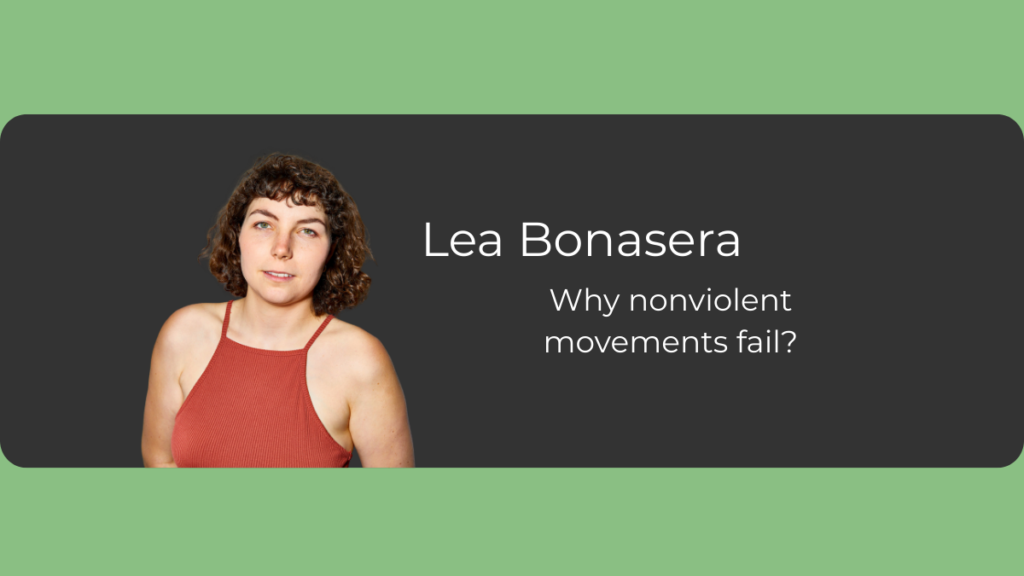
Why Nonviolent Resistance Fails: Lessons from a climate activist-scholar in Germany

While we often study successful movements to understand what works, there’s equally valuable knowledge to be gained from examining why campaigns fail. In her article for the Journal of Resistance Studies, Lea Bonasera, who is both a scholar and co-founder of climate campaigns including Letzte Generation (Last Generation) in Germany, brings an insider’s perspective to the critical question: Why do nonviolent resistance movements sometimes collapse despite their best efforts?
This question isn’t merely academic. For activists who put themselves on the line for causes they believe in, understanding the internal mechanisms of failure can mean the difference between creating meaningful change and watching a movement dissolve without achieving its goals.
“Most research focuses on the external factors behind movement failures—government repression, media framing, or unfavorable political conditions,” Bonasera notes. “But what about the internal challenges that movements can actually control?”
Her research reveals that even when external conditions are favorable, internal weaknesses can undermine a campaign’s effectiveness.As Bonasera writes, viewing these challenges as “opportunities for constructive failure” may ultimately increase movements’ chances of success. After all, in the words of organizer Kali Akuno that she quotes, failures are often “necessary stages in the growth of the dream we become to fulfill.”
The Activist Behind the Research: Lea Bonasera’s Journey
What makes Bonasera’s research particularly valuable is her extensive firsthand experience in nonviolent resistance campaigns. Far from being an academic studying movements from a distance, she has spent nearly a decade on the frontlines of climate activism in Germany.
Her journey began in 2015 when she attended the UN Climate Change Conference (COP) in Paris, which sparked her involvement in environmental groups at her universities. When the Fridays for Future movement emerged, she joined demonstrations and participated in a college occupation at Oxford University to push for fossil fuel divestment—an experience that would later inspire her master’s thesis on Extinction Rebellion.
Bonasera later joined Extinction Rebellion Germany’s strategy team from 2020 to 2021. Seeking a more strategic approach to climate activism, she then co-founded Letzte Generation (Last Generation) Germany in 2021, one of Europe’s most prominent climate resistance groups. Under her co-leadership, the campaign mobilized thousands of people in disruptive actions including road blockades, airport protests, and ministerial demonstrations.
After leaving Letzte Generation’s core team in November 2023, she co-founded a new campaign called Guter Grund, which focuses on planetary boundaries and agricultural issues.
This unusual trajectory—from participant to co-founder to researcher—gives Bonasera an insider perspective . Her autoethnographic approach, supplemented by conversations with fellow activists and workshops examining movement failures, provides rare insights into the internal workings and challenges of resistance campaigns.
As she notes in her article: “My involvement in these groups has encompassed participation in daily strategy meetings, direct actions, talks, trainings, networking, negotiations with politicians including the German chancellor and vice chancellor, press appearances and widespread conversations with hundreds of protesters, which allowed me to deeply observe internal dynamics.”
This combination of academic rigor and activist experience allows Bonasera to bridge theory and practice, offering nuanced analysis that resonates with both researchers and those doing the work of organizing for change.
Bonasera also recently published the book “Die Zeit für Mut ist jetzt” by Fischer Verlag, and runs the podcast “Tee und Taktik” with Dr. Dalilah Shemia-Goeke.

Responses