For more than a decade, religious violence has ravaged some Christian communities in Nigeria, especially in the northern region with an estimate of 130,783 Christian deaths, 82,000 abducted, and about 19,800 church attacks recorded from 2009 through mid-2026. Faith-based nonviolent resistance has emerged as a potent strategy in resisting violent attacks on Christian communities in Nigeria. Nonviolent strategies such as protest demonstrations have in the past been employed by a few Christians and activists in northern Nigeria to amplify their voices against the incessant violent attacks on Christian communities. The strategy included tactics such as marches, banners, speeches by stakeholders, and social media to attract the attention of the Nigerian government.
Beyond the traditional protest tactics highlighted, one method that has recently and consistently been utilized by aggrieved Christian communities in Nigeria is the weaponization of mourning as a nonviolent resistance strategy. Grief is portrayed as a moment of weakness, sorrow, and vulnerability. Relatives and sympathizers of victims of violent attacks utilized it to transform their grievances into strategic mourning for social justice. Mourning as nonviolent resistance method has historically succeeded in undermining injustices and transforming oppressions, such as the funeral of a 14-year-old Emmett Till. It was also used as a political protest act where the killing of Steve Biko was a watershed that cracked the foundation of apartheid.
In Nigeria, strategic mourning tactics, such as funeral demonstrations, lamentation and strategic creative mourning, are utilized by persecuted Christian communities to transform passive grief into an act for justice. It has helped to humanize the violence, attract local and transnational support, and frame the violence not only as persecution against Christians but as a genocide.
Tactical Funeral Demonstration in Exposing Atrocities
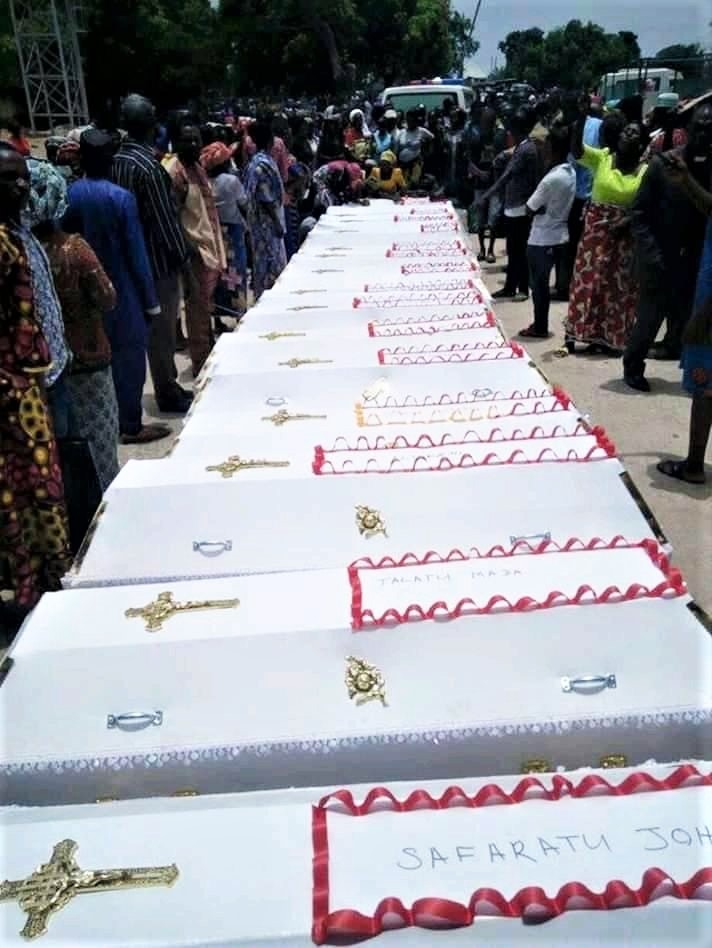
Persecuted Christian communities in Nigeria have, through utilizing Funeral demonstrations and memorials, such as engaging in public funerals and paying homage to the burial sites of victims, raised their voices about the existential threats posed by Islamic terrorists in northern Nigeria. On 25 July 2025, residents of Plateau state held a funeral procession for 27 Christians killed by a group of Islamist terrorists. Following the attack, they transported the 27 caskets carrying the dead bodies of the victims in a truck from Jos to Riyom, where the funeral was held.
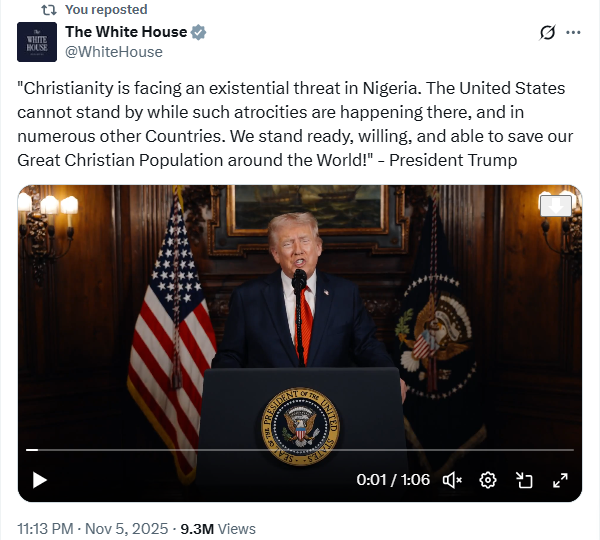
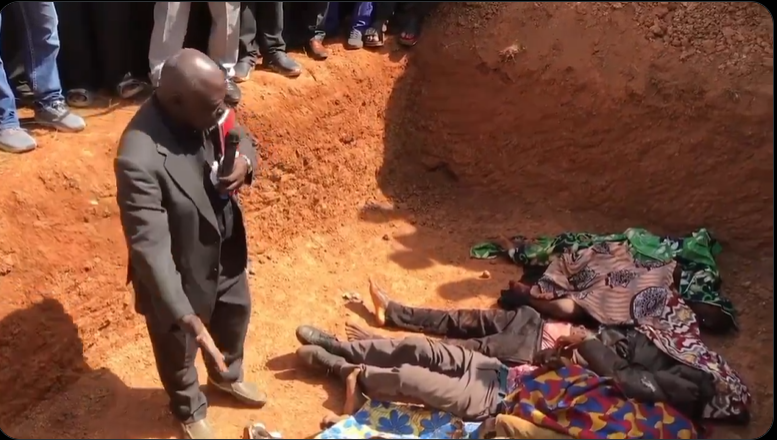
While the Nigerian government officials and conflict experts debunked the existence of Christian genocide, mourning served as a strategic protest act to inform the public of a hidden attack that has long been allegedly covered by pro-government media. Rev. Ezekiel Dachomo exposed the killings while officiating the mass burial of 12 Christians killed by Islamic militants on 15 October 2025. He went further to undermine the Nigerian government’s position that there is no Christian genocide and called for support from the United Nations and the United States. The series of protests have attracted transnational support from the United States government, thereby declaring Nigeria a Country of Particular Concern for religious freedom. Trump responded in a video published by The White House on the X platform:
Rev. Dachomo, standing beside dead bodies in a wide grave, as shown in a video and shown in the image below, and simultaneously calling for global support against terrorists who are killing Christians, reveals a strategic way of utilizing mourning the dead as a protest tool to amplify the voices of the oppressed. In his statement, he thought it necessary to document the violence “so the world will not deny or forget the scale of the killings”, confirming the strategic use of mourning as a protest act and leveraging the media in amplifying the voices of victims of terrorism.
Using Lamentation as a Transformative Power to Attract Local and Global Sympathy
Aside from funeral demonstrations, a key symbolic act utilized as a protest tactic was lamentation, the practice of public tears and wailing, which has remained a major way in mourning the dead, naming violence, and a transformative power to move against social injustice without surrendering to hopelessness and despair. Rev. Dachomo’s lamentation campaign while burying the victim of the violent attacks sent a major message that attracted local and transnational support and voice as shown in the video where he called on the United Nations and, United States to come to the rescue of neglected Christians in northern Nigeria.
External support of oppressed dissidents has proven to be historically productive against oppression, as shown in Erica Chenoweth and Maria Stephan’s research. The case of the agitators against Christian persecution in Nigeria corroborates the idea of how nonviolent resistance attracts sympathizers and support relative to violent resistance.
Nonetheless, the Nigerian situation has generated several biases. Trump’s earlier interest in sending U.S. military forces to Nigeria is suggested by a few analysts to be based on Nigeria’s refusal to honour a U.S. request that it take in Venezuelan deportees and geopolitical interests in the Nigerian resources. Notwithstanding, U.S air strikes against Islamic States on 25 December 2025 marked the beginning of its military intervention against the persecution of Christians by extremists in northern region. This has generated several mixed reactions as the United States vowed to wipe out terrorism in Nigeria.
Strategic Creative Mourning and the Amplification of Grievances
Persecuted Christian communities in Nigeria and their sympathizers have utilized collective creative mourning as a resistance tactic to amplify their voice. The tactics include the use of grief writing, strategic storytelling, and the sharing of victims’ stories. They document persecution by sharing and telling stories of incidents of atrocities perpetuated against unarmed and innocent Christians across Nigeria who were killed for their faith, and thousands of churches and Christian schools were destroyed. One of the notable stories is the story of the killings of more than 500 Christians in late February 2016 in Agatu and about 280 massacred by the Islamist extremists in 2025 in Benue state, among others.

Several Lessons for Marginalized Communities and Dissidents Facing Violent Attacks
Strategic mourning amplifies the principle of nonviolent resistance. It helps to humanize the crisis, garnered media attention, attracted local and transnational support, and framed oppression as injustice. In the context of Nigeria, it is also putting the Islamic extremists, their non-state sympathizers, and the alleged complicit government in a position of indignity towards human lives. It is also cracking their legitimacy to speak in favour of the violent Islamic group.
This also serves as lessons for movements and campaigns groups who are losing their members and activists to violent authoritarian government worldwide to explore strategic mourning as resistance strategy to push back repression and transform oppressive systems.
Such resistance should guard against the burnout of activists and dissidents who are not fully trained in activism or have taken it as a way of life. Training that focuses on nonviolent means of countering repression and resilience building to prepare against state repression, including attempts to ban funeral processions and utilize pro-government media to cover up future possible violent attacks.